Showing posts with label Life in Japan. Show all posts

Friday, November 11, 2016

Only in Japan: Masters of Mochi

Traditional Japanese Mochi Photo taken from pinterest


It`s been over 10 years in Japan for me and you see a lot of things that can amaze you and I post them as things only in japan.  They can be shocking or funny or inspirational.  This video was recorded by a good friend of mine, Pastor Rie.  She has a great blog in Japanese here for anyone interested.

GOD`S WORD PARADISE

The video below is of mochi being made by one of the best in the world.  The speed and performance recording by Pastor Rie`s video is amazing.  This is her favorite place to buy Mochi which is a Japanese sweet rice treat.  This is green because the flavor of the Mochi is Matcha a powered refined green tea in Japan.  The shouts of the mochi master gives the rhythm to the man with the hammer so that they can coordinate to make the mochi fast.  The rice starts out as regular rice and as it is pounded it becomes like dough and is usually served with sweet beans.
This was taken in Kyoto, Japan.


Something like this you can only see in JAPAN.  Everyday this man makes mochi and is a master of it.

Below is another video with subtitles that has interview with the same man.


Friday, September 16, 2016

The Kids sing Amazing Grace. God let that be the foundation of our families!


image from Ministry to Children

Last weekend my kids got to be part of worship up in front and lead everyone in the song Amazing Grace. Although the song is in English it is very well known in Japan.  It is played at weddings and on dramas of all kinds even though they aren`t Christian.  Seeing my family be a part of the ministry is very exciting.  Today I spoke on the GBC-radio on our show this morning about Christ being the cornerstone or the foundation of our lives.  At that means just more than our individual lives but our collective communities, families and marriages.  The rock is solid and we can lean into in without the fear of things falling apart.  This is what Jesus wants us to do.  He is strong and able and we can stand and have peace in the storm if he is our ROCK the foundation of the lives.  And even if things fall apart we have His amazing grace with us always.


Thursday, April 28, 2016

Tales from Japan: The Aftermath of the Great Kumamoto Earthquake

Near Mashiki the epicenter of the Kumamoto Quake entire blocks of houses have become rubble


It has been way too long since I have posted a blog.  But I promise you after recent events I have the determination in the midst of the busyness and storm of life to keep all of you readers up to date and informed on life in Japan.  At the moment I am still catching my breath from the last three days of non stop travel and supply runs and other volunteer work down in the devastated areas of Kumamoto Japan.

I have taken in a lot from this experience and I hope I have given back something worthy of a blessing for the people who have lost nearly everything.  My heart goes out to them... I didn`t shed a tear while I was there but I could not contain myself on the ride home. I watched and talked to little children in front of a collapsed house, not knowing that their parents may not have survived (I dare not ask).  Their grandparents or neighbors were looking after them at the time.  That`s just one of many scenes that had a dramatic impact on me.

This man lost his house you can actually see the fault lines in the pavement.  He is watching the crane demolish the house he built.

This house happened to be sitting on the fault when the quake struck.  The man said he was happy to be alive.


So looking at all this and all the wonderful people coming out to help or give of their finances and resources to aid all these hurting people I can`t help but feel grateful to be part of this.  As humans we are all linked and connected to one another, certainly Facebook and social media should make us realize how true this is.


We asked the local supply center if they needed any more things.  They were happy to see us and we talked about what we could do in the days ahead.

We spoke with people who are afraid to go back in their home and have been living for 2 weeks in tents in their yard.


Obviously people are asking the classic question of WHY? and while profound I think that isn`t an relevant question.  Perhaps a more helpful question is "What now?" People need forward motion and hope is a big part of that.  People reaching people gives HOPE.  And even more as Christians, do we carry the message of HOPE in the Gospel of Christ.

There is a lot of work to be done, but in this labor, LOVE will give birth to HOPE for many Japanese as volunteers rally together and experience what binds and connects us.  People will lay down their quarrels and their social barriers.  If anything I see something so beautiful in this mess: the power of LOVE and UNITY.

So in all we do let LOVE be our supreme purpose.  And LOVE is seen in our actions.

To donate to the work we are doing for KUMAMOTO go to paypal.com and send to stevetsunami@yahoo.com  or click the DONATE button at the top of the page.

Thanks for reading! ARIGATO!


Saturday, April 04, 2015

Only in Japan: Company Parties under the Yozakura


Beautiful Night time Cherry Blossoms in Fukuoka Japan


HANAMI 花見  (literally translated Flower Watching as it is called in Japanese) can only be done in a short period in Japan when the cherry blossoms 桜 (SAKURA) are in bloom.  This typically lasts for about a week or so near the end of March or beginning of April. As winter comes to an end there is an air of festivity as people begin to anticipate the blooming of the SAKURA.

Many families, friends, and even companies take time to have lunch or picnic under the cherry blossoms.  Sometimes this is during the day and it is also done
 at night.  As you can see here in Fukuoka there is a lot of work done to light up the SAKURA around the old castle ruins downtown.

Night time sakura in downtown Fukuoka Japan, castle ruins


Most parties tend to go late into the evening as people drink and celebrate the coming of spring and often new changes in their lives. At this time many people start new jobs or in the case of students new schools.


Japanese people gathering under the sakura for a company party

The nightime viewing of SAKURA is called YO-ZAKURA (夜桜).  The first character is one for night.  This adds a special and unique flavor to the typical concept of a picnic.  Something that you can only really find in Japan where literally thousands of people around town roll out their tarps and mats and pour out their sake for the night.

Wednesday, July 03, 2013

Only in Japan: Kimokawa Dwarfs - コヒと図鑑

 Some of The KOBITO dwarfs from the Dwarf Encyclopedia コヒと図鑑 

There is a peculiar phenomenon that happens in Japan when cute and ugly mix together. This kimokawa (words for grotesque and cute put together) phenomenon is sublimely personified by the kobito zukan, literally meaning dwarf encyclopedia.  This creation is both hilarious and astoundingly creative. Each page detailed about the behaviors, habits, and ways to capture these dwarfs as well as ways to care for them.

The dwarfs themselves are grossly depicted but are tiny and small and have a cuteness to them.

The popularity of the Kobito series has rivaled Pokemon as a regular topic of discussion for Japanese grade school children.

I will let the short video in English subtitles tell the story.


Each dwarf is well thought out and has some ridiculous ability like flying, turning milk into soy milk, growing mushrooms on its head, or pooping gold out of its head.


There isn't much to say but laugh while you discover the world of these silly dwarfs that the creator often connects to Japanese culture, history, or humor.

This a clip from the DVD series that tells you how to capture them.  No subtitles but still silly.

Tuesday, June 04, 2013

Only in Japan: Sake Vending Machines in Public

A typical alcoholic beverage vending machine in Fukuoka City, Japan. The red lights say "Urikiri" which means sold out.

Vending machines are everywhere in Japan, their products various and humorous. Much like many other developed economies, convenience sells tremendously well. 

But something you won't see sold in many other countries is alcohol with vending machines.  This is for obvious reasons: theft, underage drinking prevention, fire safety, the list goes on.

In Japan alcohol is readily available all the time and any time you want it or in some cases need it.  Consumption of alcohol is very common in Japan and some people are concerned about alcoholism being a source of many domesticated problems, but the fact of the matter is, even with the large amounts of alcohol being consumed in Japan, the crime rate per capita is extremely low, although strict regulation is now being enforced on drunk driving.

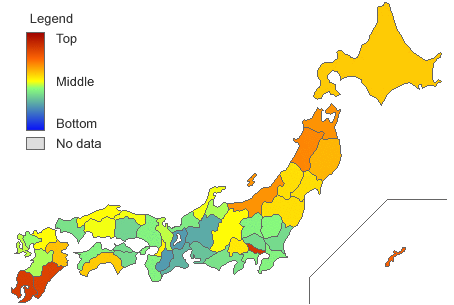
The main concern over alcoholism is for health reasons in Japan. See the chart  below to see what area drinks the most

Consumption of Alcohol
Note that Tokyo is red surrounded by green and Fukuoka is around the middle range located in the most southern area of Japan (Kyuushuu).  Kagoshima is the highest consumer of alcohol in Japan, also located in Kyuushuu.  Okinawa is the small island located on the right.


In regards to vending machines, most have been equipped with a taspo card reader that assures the purchaser is of age.  The same goes for vending machines that sell cigarettes.


Many foreigners find the lack of strict regulation on alcohol and tobacco a surprise, but in Japan most people are not worried about it at all. Alcohol and tobacco have their role in society and this is accepted despite their known negative affects on health.

So if you like Japanese Sake, no need to worry about ever running out in Japan because there is always a place you can find it relatively close by.

Tuesday, May 28, 2013

Only in Japan: Corn flavored Popsicles with real kernels


The other day I decided to go on a little flavor adventure and try a corn Popsicle. The brand GariGari Kun is probably the most well know brand of 
アイス (frozen treats) you will find in Japan. 

It ranges from about 60 yen (60 cents) to 120 yen ($1.20) a bar.  It took off in the 1980s and has been on the top sellers for years. Japan loves to experiment with flavors and GariGari Kun certainly seems to enjoy exploring the flavor palette.

It's Corn Potage soup flavored Popsicle has frozen corn kernels in it as well. Surprisingly the Popsicles melts in your mouth quickly which thaws the corn chunks.  I found it quite tasty at first but near the end the novelty wore off.

Would I buy it again? Probably not... I think I'll stick to their standard soda flavored one.


Just in case you are curious about the name GariGari, it is a play on words in Japanese.  GariGari is the sound made when chewing something grainy like shaved ice which is actually in the center of the Popsicle.


This is just one example of the Japanese sales approach to create a buzz by taking something that is famous and beloved by the public and repackaging it or adding a new flavor.  It is quite successful I think, it worked on me.


Sunday, May 19, 2013

Fukuoka- Land of Blessed Hills

Fukuoka 福岡- Land of Blessed Hills
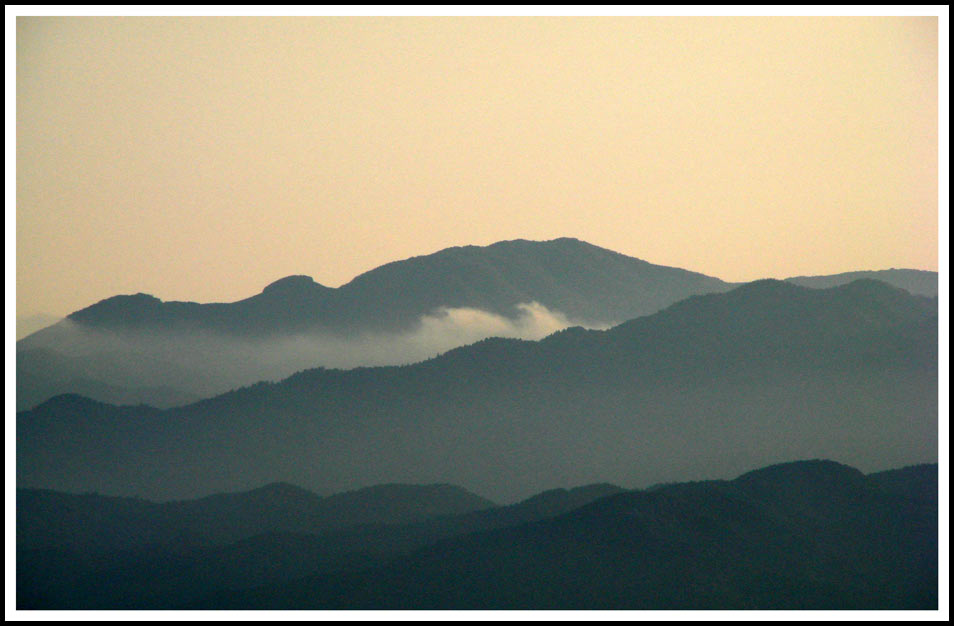
The mountain range surrounding the city of Fukuoka- image taken from Fullthangka
We are now living in Fukuoka City, literally meaning "Blessed Hills" in Japanese.  Here we have a place to call home and though it still feels foreign in many ways we are becoming acquainted with it daily.  Fukuoka city was shown to me as I sought the Lord in prayer last year. God's Divine Wind- Call to Fukuoka

We have fought our way to get here and through many trials and sufferings that seemed to hold us back we have come. I cannot fully detail all of them in a single post, so I will leave it for a later time.  What is important is that we have arrived and we are grateful to God and the many who helped us along the way.

Fukuoka City is one of the oldest cities in Japan. It has a rich history and has been ranked as one of the most livable in the World according to Wikipedia.

http://en.wikipedia.org/wiki/Fukuoka

However, I have yet to come such a conclusion seeing I have been here less than two months.  There are certainly a lot of things to explore.  With time I hope I am able to see and understand the reason we are here.

Reasons and purpose give us hope.  If we only exist in space and time merely for the purpose of existence hope begins to slip away.  Hope is an enduring virtue that the apostle Paul writes about saying,

"Three things will last forever--faith, hope, and love--and the greatest of these is love."

I Corinthians 13:13

Hope keeps us going in the midst of our sufferings and difficulties, being bonded with faith and love.  It is a bond not easily broken, nor a bond that will fade away.


Looking into the future,

There are many challenges ahead of us and we are challenged daily as we settle in this land.
We look forward to the blessings to come as we labor and work for the Kingdom of God.


Two women wearing kimono stroll down a street in Daimyo, downtown Fukuoka City.

It is clear to see that in Fukuoka there is great attention and resources spent of fashion and aesthetic pleasure but something is missing.  In the midst of all the glamour and decor there seems to be a loneliness, a hollow vanity.  So many people dressed up in their best but the look of searching is still on their faces.  There is a wanting that is hard to describe.  I admire the many wonderful and interesting things I see in Fukuoka, but I hope that these searching souls may find rest and peace in the Gospel of Christ.

Of course like any metropolitan city there are urban characteristics that leave the heart longing for the beauty of nature, which is only a half hour drive away.  It is a city that seems to have sprung up in middle of the wild.  Surrounded by mountains and accompanied by a beautiful bay area it makes for quite a unique place in Japan.

Fukuoka City night skyline-image taken from wikipedia


This is the place of the Divine Call and we marvel that we are here today. I cannot pretend that I knew it would work out this way, I merely believed in the One who can make such things possible.


Jesus looked at them and said, “With man this is impossible, but with God all things are possible.”


Matthew 19:26

When I am tired and confused, lost and hurt He reaches down in the way only He can to revive me and put me back on the path He has made for me.


For I know the plans I have for you,” declares the Lord, “plans to prosper you and not to harm you, plans to give you hope and a future.

Jeremiah 29:11


It is an amazing experience when you actual experience the Word of God through living by faith and seeing events come to pass that mirror the experience of those in the Bible rather than study them as academia or as a root study.

Be blessed as you live your life, May you see the and experience God in great ways.

Wednesday, January 02, 2013

Only in Japan: Noodles of Longevity

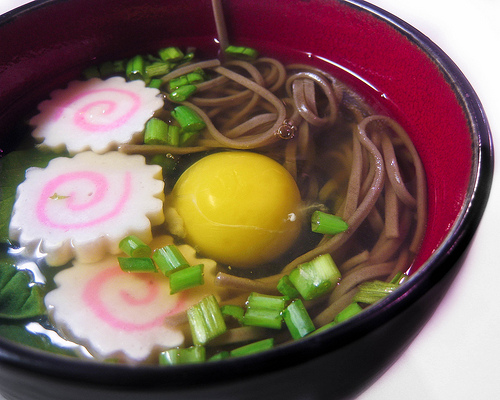
Photo taken from popartichoke

In Japan it's a tradition to have soba noodles on New Year's Eve.  In Japanese it is called Toshi Koshi Soba, 年越しそば. (End of the Year Soba) While many in the West are gearing up for party time, the Japanese have a more quiet tradition that dates back hundreds of years to the Edo period.
Most of these seasonal traditions in Japan are rooted in superstition.  The long noodles symbolize a long life, so as the New Year starts you have in a sense the promise or blessing of a long life with you as you partake of the food. It certainly isn't something Japanese take too seriously, but it is something to ponder. 

As it is with many Japanese customs, behind the superstition there is a pearl of wisdom to be found that people long ago discovered and passed on. Using the form of superstition or tradition the Japanese preserve the wisdom and memory of their ancestors. In Japan the fall harvest time is a festive time of feasting and eating while the food from the harvest is still good.  As the year comes to an end in December, there are still gatherings in the form of feasts and merryment in order to forget all the troubles of the year gone bye called Bo Nen Kai 忘年会. After all the gorging and drinking, it most have seemed the healthy way for the Japanese to embrace the New Year in sober and simple fashion with a bowl of buckwheat noodles (soba).


So as I sat and took in the warm bowl of noodles and soup, I did feel a comfort at the simplicity of the meal. There's something special about taking your time and practicing a custom with proper reflection. So will I live a long life? Well, on a cold New Year's night a bowl of warm noodles sure couldn't hurt.

Sunday, December 23, 2012

Only in Japan: Santa Elves grilling Chicken at 7/11

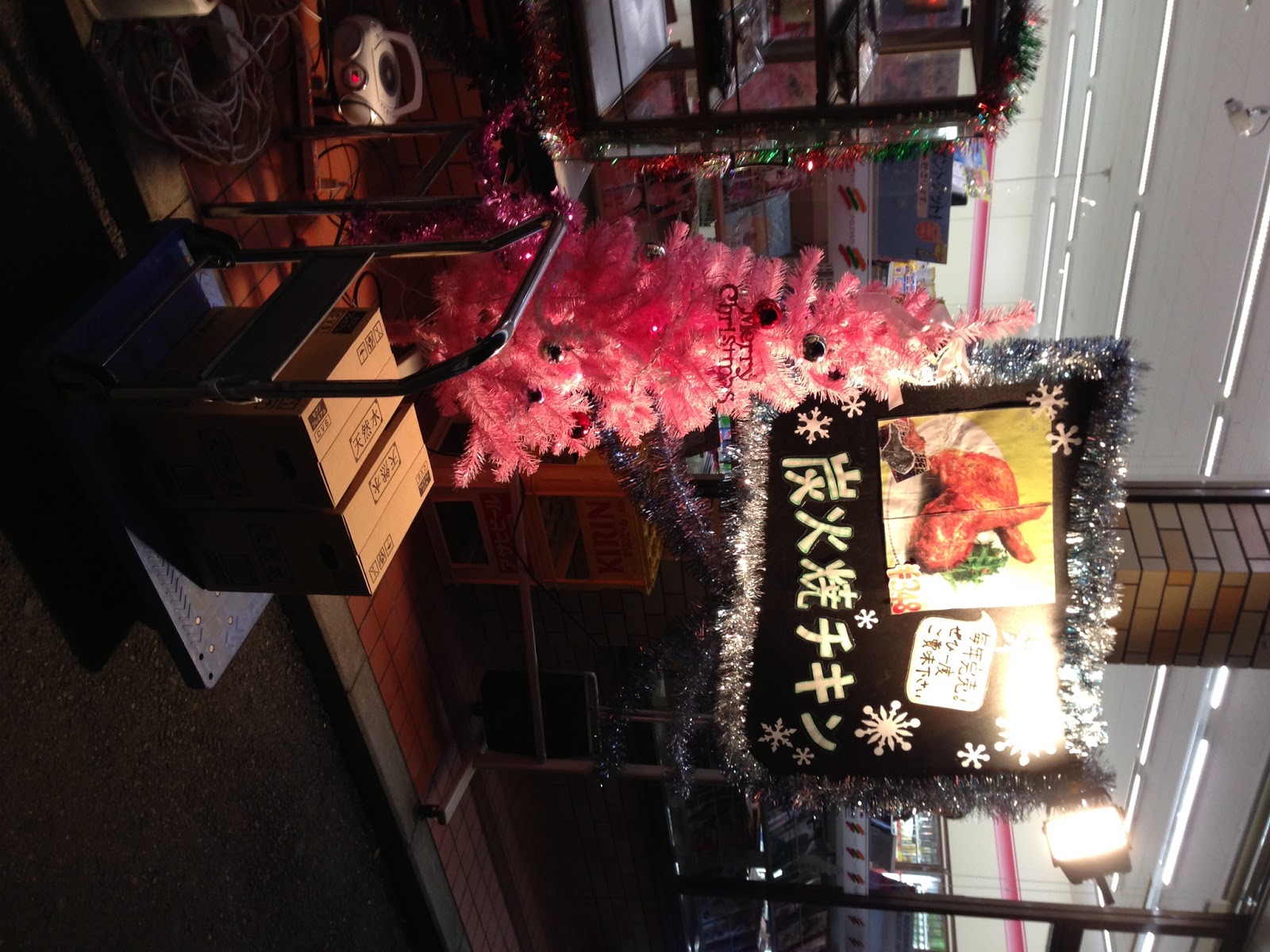
A young Japanese woman dressed in a Santa suit stands outside in the cold and grills chicken in front of a 7/11 in  Funabashi, Japan

I must stop and enjoy the efforts of the Japanese to promote Christmas.  They love uniforms in Japan and the red santa suits are a hit.  From pizza delivery boys to 7/11 employees who could resist the red and white uniform of Christmas.  They caught my attention as I rode down the street on a borrowed bicycle.

Many Japanese young employees, especially females seem to be excited with putting on a costume for work.  I guess it is kind of like Hawaiian shirt day at the office back in the U.S. except they only get it once a year.

A 7/11 worker prepares and wraps a freshly grilled  piece of chicken  two days before Christmas in Japan.


Also another thing to note is that the official food for Christmas in Japan is chicken (roasted, fried, grilled it doesn't seem to matter).  Take a look at this post on KFC Christmas in Japan 


After stopping off and wishing the elves at 7/11 a hardy "Merry Christmas" I arrived only to see the pizza guy in a full Santa suit and again wished him a "Merry Christmas."  He smiled and took off on his moped.

I hope as the trend continues that the Japanese start to dig a little deeper into the things of Christmas.  I mean why the white and red? Who was Santa Claus? Are we doing this just for the money? lol

All in all, I am try to enjoy my Christmas time in Japan although it is typically disheartening for many who esteem Christmas as something more than just a fun time to dress up.

I hope you enjoyed a little taste of Christmas on the street in Japan.

Saturday, December 22, 2012

Tales from Japan: Abe, Japan's new hope?

Shinzo Abe, soon to be Japan's new Prime Minister 2012.  Photo taken from a Liberal Democratic Party pamphlet

Just recently Japan's Diet appointed its new leader. Shinzo Abe of the conservative side of Japan's political spectrum has returned to the highest position in Japanese politics.


In the past he has had the demeanor of a more soft spoken man. At one time he was Japan's youngest Prime Minister but had to resign due to failing health.


Now he has a new tone and voice that has lit a fire under the politically indifferent Japanese culture. He has gained strong support from his stance on foreign affairs and his commitment to effective economic strategies.


I have watched him over the years and seen him be bashed repeatedly by Japanese media but he is still going strong.  The fact the media won't leave him alone makes me think perhaps there is something good about him.


This was taken from Abe's Facebook page.  It notes how when the more liberal party took power three years ago it was a "A Democratic Revolution that will Change Japan" but now with the return of the conservatives party's overwhelming victory the magazine title reads, "The Concern Over Abe's Politics".  Let the bashing begin the comment reads on the Facebook post http://www.facebook.com/abeshinzo

One thing for sure is that Shinzo Abe has a lot of pressure to perform an economic revival in Japan. Remarkably, the day after the elections the Japanese stock market soared  and the over valued yen dropped.  A sign that perhaps there is hope for this struggling nation.

We even had the rare opportunity to listen to him speak live at Funabashi station a day before the election


Mr. Abe is speaking from a platform by the far building and is mostly being blocked by trees but you can see him move slightly if you look real close, or if you can zoom in on the video.

It was about a year ago that I had a vision about Japan's future.

A White Serpent Will Appear

I don't know whether Mr. Abe is going to be a phenomenal success or a tremendous failure. But my heart is that Japan is blessed and it's people prosper. That is my prayer for them and my prayers for their leader.

The reactions of some Christians in Japan seem almost fearful as to what what might happen, if religious persecution or hardships might result from this new leadership.

I certainly do not think it could even come close to the persecutions under the shoguns of long ago.

Christian Martyrdom in Japan

If anything, let there be hope and let there be joy in the land again.  

Sunday, December 09, 2012

Tales From Japan: Back to the Island


photo taken from View World Beauty


We find ourselves back in Japan after leaving one year ago. Almost like something out of the TV series LOST. A lot of unique and supernatural events have brought us back with a new perspective and purpose.
There have been some interesting revelations and a lot of challenges over the past year but we look forward with hope.

Right before coming to Japan I had an opportunity to share about this message of hope with a Japanese man.

God is the God of hope.

Jesus' call to believe in Him instills a new hope in us. This is hope of a new life, hope for a future beyond death even, and for everything we need to accomplish the task He has set for us.

It is the hope for the new world that God will establish in the era to come that we fix our eyes upon.  The prize of heaven as the apostle Paul called it.

And it is a prize worth seeking, it is worth the confusion and suffering that we go through.  Where God is, there is LIFE and it is never ending. 

Jesus came to save souls and give them life eternally.  His primary objective was not to die for our sins but to give us life, abundant and everlasting.  The cross of Christ and His sacrifice is the great cost.  Jesus is excited about you growing in your faith through your trials.  He is overjoyed at the idea of being with you in heaven, sharing His gift of everlasting life with you.

Just look what the Word of God says

Hebrews 12:2
...Jesus the author and finisher of our faith; who for the joy that was set before him endured the cross...

Back to the story of the Japanese man...
I prayed with this Japanese man who desperately needed hope. He needed a God who is real and who cares. Our meeting was a supernatural event that beckoned me to share my faith and my hope, with this man who prayed a most beautiful prayer:


God help me...

神様僕を助けて、

Jesus please come and save a person like me...

イエスさまこんな僕を救い出して下さい


To see this man in such desperation of heart to pray without any coaching the simple sinner's prayer brought tears to my eyes.


I told him, "Today is a new day, you are reborn when you repent and turn to Him, the one who can save. Today you encountered the God of Hope"

今日あなたが生まれ変わる日です。神様を求めてイエスに信じるもの必ず助けます。今日は新しい日です。希望の神に出会いました!


So it is a new day for Japan and a new day for me. Everyday we need His grace, everyday sinner and saint. Though the Japanese may not bow at the name of Jesus, God is patient and long suffering wanting for many to turn and call upon Him like that man I met did.
We are back to this island because there is work to do and because God has a plan and purpose for many. And that plan is to give them new life and new hope for the age to come.   Thank God who works in mysterious ways and redeems all things into His glorious plan.   We look forward to many more tales to come from the land of the Rising Son.

Monday, October 15, 2012

Only in Japan: Abandoned River Bicycles


An old bicycle lay at the bottom of a river bed in Funabashi, Chiba Japan.
Often I come across this scene when I am walking along the rivers in Japan.  Funabashi is a highly populated suburb of Tokyo.  It has over half a million people crammed into an area of only around 5 square miles.  With all those people there is a lot of trash to take care of.  Typically in Japan it costs money to dispose of large things or environmentally hazardous items.  This unfortunately leads to many people who would rather toss their bike in the river than pay the 2,000 yen to have it disposed of properly.  However, sometimes these bicycles have been stolen by a person in need of quick transportation and discarded wherever convenient for the thief.  This phenomenon is called Nori-Sute 乗り捨て in Japanese.

Not only are bicycles disposed of this way but TVs, fans, mopeds, furniture and other such large or electronic devices are often seen thrown away illegally.

A sign in Machida, Tokyo warning residents not to throw away trash in this park area.  Violators could pay a fine of up to $120,000 or face up to 5 years in prison.

When I look at a bicycle or other junk sitting in the middle of Japan's enchanting landscape, I find it interesting.  It almost looks archaeological to me.  As nature slowly wraps itself around and quietly disrepairs the once shiny metal, I am reminded of Japan's serene beauty which seems to overpower and remind humanity of its place.

After all from dust we came and to dust we will return said the LORD.

GENESIS 3:19

Thursday, September 27, 2012

Only in Japan: Jumbo Sized Lucky Cats

A 600 lb Lucky Cat statue Maneki-Neko in Japanese stands outside a recycle shop in Funabashi Japan.

The first time I saw the precocious and charming characture of a maneki neko was in the United States.  It is commonly sold in Asian market places or shops that feature Japanese merchandise.  The origin is Japanese but is often confused as being Chinese. 

Wiki- Link Maneki-Neko

The "bekoning cat" as it is literally translated stands inviting customers which translates to blessing or fortune for the shop owner.  It is both whismical and captures the culture of superstition embeded in the minds of Japanese.  The history of the Maneki-Neko goes back to the Edo period about 400 years ago.  There are numerous legends and stories that account for the presence of this figurine in thousands of shops around the Japan.


Superstitous beliefs in Japan are usually associated more with protection than anything else.  One example is that Japanese will spend hundreds of dollars a year for shaman blessed charms (Omamori) for car safety, health, business dealings, school, or general bad luck.  The Japanese try to cover themselves from as much trouble as they can and while there is no guarantee in charms they take comfort in having an item that tells them they are protected.


Wikipedi Image Japanese Amulet Charms

The Maneki-Neko is different from other charms and amulets in Japan because it optimistically represents hope and blessing to come.  Most Japanese find it cute and decorative rather than actually attributing any real power to it.  Even though it represents a belief in power beyond that of human effort, the Japanese know that hard work is perhaps the most important part of success.  That being said, to the Japanese there is nothing wrong with having a little more luck on your side.

Tuesday, September 25, 2012

Tales from Japan: Japan an Island in Conflict


A man burns a Japanese flag in China protesting the nationalizing of the Senkaku Islands.

I usually stay away from political issues.  And for the most part I will not address the lengthy and complex historical issues that have led to the current conflict with China and the ongoing conflicts with the Korean countries.

In general most Japanese do not speak well of their own country.  They may have feelings of respect and appreciation for their country but rarely articulate it as "pride." They seem to be confident in Japanese tradition and culture, but are shameful of its current state of economic and moral decline.  It's economic situation is an objective reality but its moral situation is certainly a subjective topic of discussion.

When the Japanese government purchased the Senkaku Islands from their private Japanese owner, Japanese saw nothing wrong.  Apparently the Chinese government and its people thought differently.  The leaders in the Japanese government claim that it nationalized the islands to prevent them from being developed further by the building of structures supported under the right wing mayor of Tokyo Shintaro Ishihara.  The Japanese government thought such potential action to build on the islands surrounding China might cause even greater damage of relations between Asian powers.  They saw nationalization as a prevention measure not an aggressive action.

One thing for sure is the nationalistic response in China is quite stark in contrast to that of Japan.  Japanese are not burning things, rioting, or posing any danger to the large Chinese population in its country.  There now finally seems to be demonstrating taking place in Japan in response to the volatile reaction of the Chinese towards the Japanese.

http://www.msnbc.msn.com/id/49141889/ns/world_news-asia_pacific/t/japan-china-military-conflict-seen-unlikely-despite-tension/


Some might say that the Japanese government perhaps is attempting to stoke the fire of nationalism in Japan which seems to be very dim, especially with the long stagnant economy and the catastrophic tsunami and nuclear meltdown in Fukushima in 2011. By taking the hard line it forces a violent reaction which would in turn spark a Japanese public reaction to support their struggling government.  It is clear that the Japanese government wants to get the attention of its people who seem to be indifferent or frustrated with the political state of Japan.

One might argue that a sense of national pride and a little trust in the government might not be entirely a bad thing for Japan.  However, I think there needs to be some serious house cleaning that needs to happen first.

But even with all the media attention most experts do not see the situation escalating towards war between Japan and China.  They are big trade partners and any full scale military measures would most likely result in an economic collapse in both countries.

http://rt.com/business/news/china-japan-trade-earthquake-382/

Looking toward the future of Japan, I see the samurai spirit of Japan being stirred up by all these things happening.  The samurai warrior is the protector and is governed by loyalty and justice.  The Japanese are a strong people who have a history going back thousands of years.  I do not think they will back down if put in a corner.

According to a recent survey done in the light of the conflict, 34% of Japanese polled believed the government should invest more money into the defense of Japan by the Jieitai 自衛隊 (Japanese Self Defense Force), the current name of the Japanese quasi-military. Officially, the Jieitai cannot fight in war or take part in an invasion of another country even if it is accompaning an ally. The U.S. government has made it so that the Japanese can never make war or maintain a military.

The true reality of situation is that the Japanese are in the midst of an internal struggle of how to view itself in the world and even more the particular region of Asia.  Whatever happens I hope and pray the best for them.  No matter what has happened in the past they have been through a lot as a country the last few years.

Monday, March 19, 2012

Tales From Japan: The Coming of the Great Tokai Earthquake in 20??

Captured as one of the most startling images of 2011 from National Geographic.  Lighting sparks as volcano erupts in Kyuushuu Japan.

An image of an erupting volcano in Kyuushuu Japan. Mt Shinmoedake is the most recent major volcanic eruption on the island of Japan. It erupted in January 2011 and subsequently a few more times afterward leading to the evacuation of a few hundred local residents. The department of Japan's government who handles such issues raised the level of emergency to a level 3 out of 5. Level 5 is a full blown eruption requiring the immediate evacuation of all local residents and subsequent areas of danger.


Japan Metereological Agency explanation of levels and safety measures


Looking at the history of Japan and its seismic and volcanic activity reveals a harsh and fearful reality.  It is difficult to accept that many will die, many more injured and scarred for life by the trauma of it all.  Yet the earth continues on without malice nor a whim of our concern. The truth of the matter is that the earth has a schedule to keep and our presence will simply not detour it.  A great earthquake is always brewing, especially in Japan where seismologists have upped the percent of a magnitude 9+ earthquake hitting the Kanto region in the next 30 years to 87%, though some put it even higher into the upper 90th pecentile.

While Japanese are confident in their building technology and prevention measures, as March 11, 2011 demonstrated, nature can exceed human preparation and expectation.  The Great East Japan Earthquake devastated Japan but not nearly as much as a potential M9 earthquake even closer to the highly populated capital and metropolitan area of Tokyo.

More info here
Researchers raise level of great Earthquake to hit Japan

Although scientists do not exactly know when an earthquake will hit they have a clear understanding of their cyclical nature and early warning technology is still advancing.  In fact, the Great Tohoku Earthquake was actually detected 1 minute in Tokyo before the earthquake began.  This perhaps gave some people a moment to find a safe area or take cover.

Below is a video in Japanese that explains the sure inevitability of the Great Tokai Earthquake that will come in our lifetime.  The scary thing is that on this 300 year cycle as before Mount Fuji is bound to erupt.  That means that this next Tokai quake will most likely be 1000 times stronger than the Great Tokyo Earthquake of 1923.


(The video is in Japanese but needs no real translation just watch the visuals and you will get the idea. Plus if your studying Japanese there is some motivation for you).

Beside Japan there is also talk of a great earthquake and tsunami that will hit the west coast of the United States. Many experts are concerned with the continued high activity on the pacific ring of fire and some believe that another great earthquake will occur in 2012 somewhere along it.


Some experts see the potential for another Great Earthquake along the Juan de Fuca plate devastating Oregon and triggering massive and destructive tsunamis along the west coast of America.  This earthquake like the Tokai Earthquake in Japan is due to occur this century.

More info here
The Great Coming Cascadia Earthquake

The population of the world is increasing and people are naturally drawn to live in places near fault lines which tend to have properties conducive to human settlement.  This is the conundrum that humanity faces as civilization evolves and progresses.

For an island people like the Japanese there seems to be little but no choice to invent, improve, or adjust to drastic living conditions in order to survive.  This is their fate and many of them affirm it and have strong resolve to prepare for great disaster because...

The next Big One could be tomorrow!
blog ping